
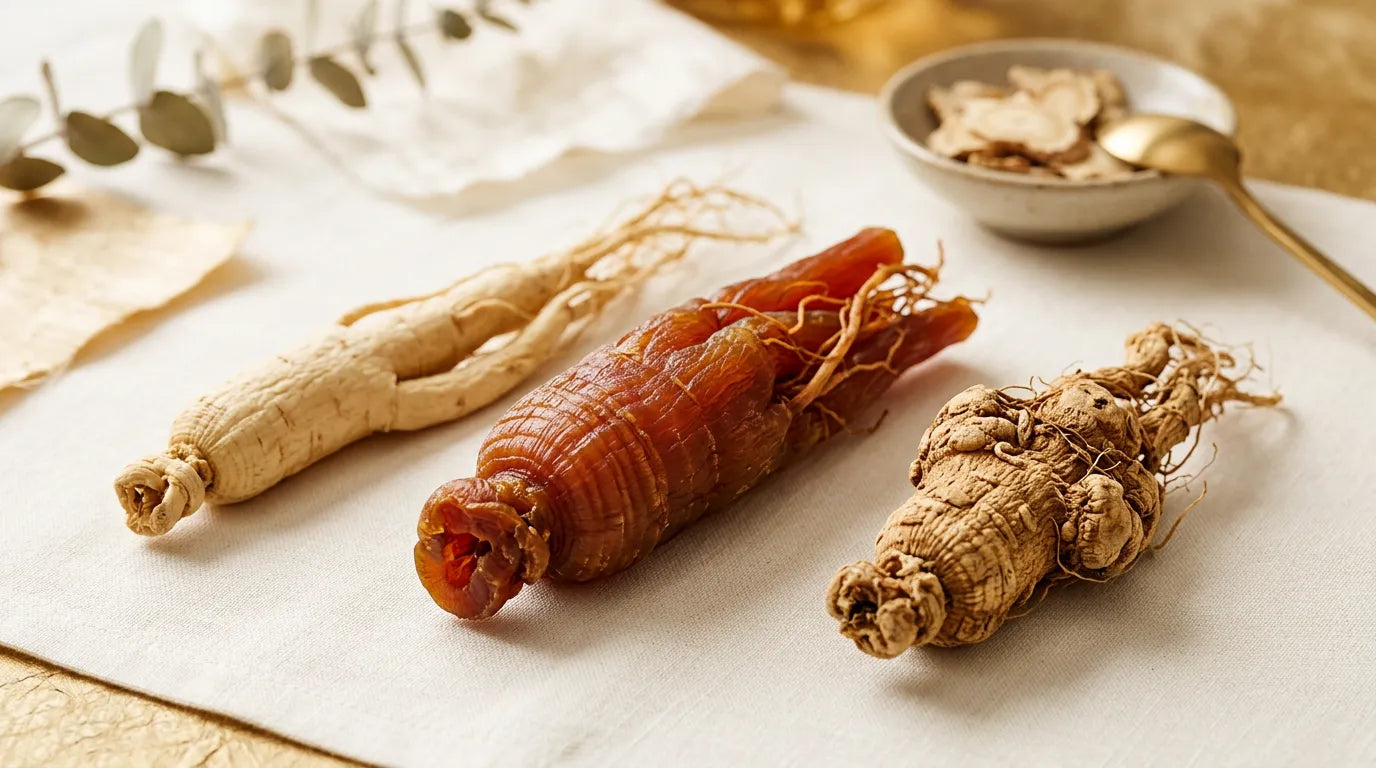

"Ginseng" sounds like one thing. It isn't. The root sold as American ginseng, the one sold as Chinese ginseng, and Korean ginseng are genuinely different plants with different chemistry — and the gap is bigger than most labels let on. If you're going to pay for ginseng, it's worth knowing which one you're actually holding.
Three roots, three plants
The name covers several distinct species. The most common you'll meet on a shelf:
| Type | Plant | Mainly grown in |
|---|---|---|
| American ginseng | Panax quinquefolius | U.S., Canada |
| Chinese / Tienchi | Panax notoginseng | China |
| Korean ginseng | Panax ginseng | Korea |
They share a family, but their active-compound profiles diverge — and that's where the real comparison lives.
The number that separates them: ginsenoside diversity
Ginseng's signature compounds are ginsenosides — the specially-named saponins we broke down in a separate piece. What's striking is how the number of types differs by species. When researchers compared the ginsenosides isolated from the world's ginsengs, the spread looked like this:
| Ginseng | Types of ginsenoside identified |
|---|---|
| American (Hwagi) | 13 |
| Chinese Tienchi | 15 |
| Korean ginseng (fresh) | 25 |
| Korean red ginseng | 43 |
Source: Korean Society of Ginseng / Journal of Ginseng Research, comparative analyses of ginsenoside types across Panax species.
Korean ginseng already carries the widest range. And once it's processed into red ginseng through traditional steaming, the count rises further still — to a profile that no other common ginseng matches. The number matters because, as a family of compounds, ginsenosides are associated with different areas of wellness; a wider spread means a fuller, more complete profile rather than a single note played loudly.
Why steaming is the turning point
Here's the step that sets Korean red ginseng apart. Fresh Korean ginseng is steamed at around 95–100°C for a few hours and then dried. That process — called "red-ginsenging" — doesn't just preserve the root; it transforms it. New ginsenosides that weren't meaningfully present in the fresh root appear, including rare ones like Rg3 that have become markers of quality processing. The same steaming step also raises the non-saponin compounds, which we'll come back to.
A safety note that's easy to miss: many ordinary plant saponins can rupture red blood cells — which is why you don't consume most raw saponin-rich plants in quantity. Ginseng's saponins are structurally different and recognized for being gentle enough for regular use. That's a meaningful distinction when you're choosing something to take daily, over the long term.
It's not only the ginsenosides
Comparisons usually stop at ginsenosides. They shouldn't. Korean ginseng — and red ginseng especially — also leads on the non-saponin side:
- Polyacetylenes — Korean red ginseng showed the highest content among the world's ginsengs in comparative analysis, ahead of Tienchi and American.
- Acidic polysaccharides — Korean ginseng carries notably higher levels than other ginsengs, and these are higher in red ginseng than in the fresh root.
These non-saponin compounds are discussed in relation to antioxidant balance and immune support, and they're a big reason the full value of red ginseng is understood to come from saponins and non-saponins working together — what we mean by full-spectrum. The complete breakdown sits on The Science page.
So which ginseng is "best"?
"Best" depends on what you want — American ginseng has its own traditional reputation, and Tienchi is used differently again. But if your aim is the widest, most complete natural profile in a single root, the comparison is hard to argue with: Korean red ginseng carries the broadest ginsenoside range and the strongest non-saponin showing of the common ginsengs. That's not marketing language; it's what the comparative research describes.
Which is exactly why, when you're paying ginseng prices, the species and the processing on the label matter as much as the milligrams.
The full-spectrum kind Dr. Choi's is 6-year Korean red ginseng from Geumsan — steamed the traditional way, Rg3-enhanced by patented process, full spectrum kept intact, and lab-tested every batch.
Explore the ginseng →* These statements have not been evaluated by the Food and Drug Administration. This product is not intended to diagnose, treat, cure, or prevent any disease. The compound comparisons described here reflect published analyses and areas of ongoing research, not guaranteed effects, and individual responses vary. This article is for educational purposes and is not medical advice; if you are pregnant, nursing, taking medication, or managing a health condition, consult a qualified healthcare professional before starting any supplement.